
What Are Stem Cells?
Stem cells are cells that can renew themselves and, under suitable conditions, develop into different cell types. Adult tissues such as fat tissue and bone marrow contain mesenchymal stem/stromal cells (MSCs). In aesthetic dermatology, the interest lies less in these cells forming new skin directly and more in their ability to influence surrounding tissue through the biological signals they release (paracrine effect).
In everyday language, “stem cell application” may be used for very different methods. Yet a cell mixture obtained from a person's own fat tissue (SVF), laboratory-expanded cells (ADSC), plasma prepared from blood (PRP) and extracellular vesicles (exosomes) are biologically different and are not the same treatment. This guide discusses each of them separately.
Skin Structure and Cellular Renewal
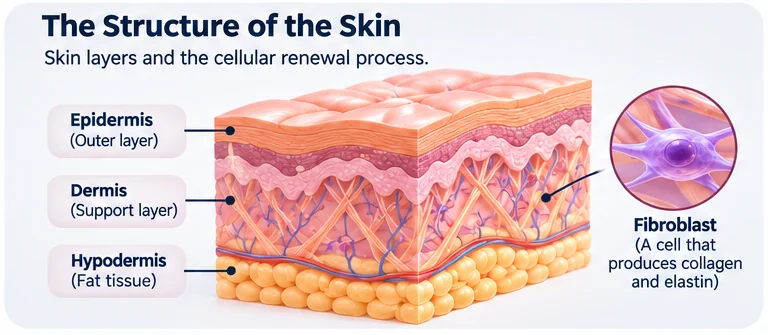
The skin consists of three main layers. The outermost epidermis forms the protective barrier and its cells renew continuously. Beneath it, the dermis contains collagen and elastin fibres produced by fibroblasts; the firmness and elasticity of the skin depend largely on this layer. The deepest layer, the subcutaneous fat tissue, provides support and volume.
With age, sunlight, smoking and genetic factors, cellular renewal slows down; collagen production decreases and fine lines, dullness and loss of elasticity may become more visible. Regenerative approaches aim to support these renewal processes.
Cellular Mechanisms
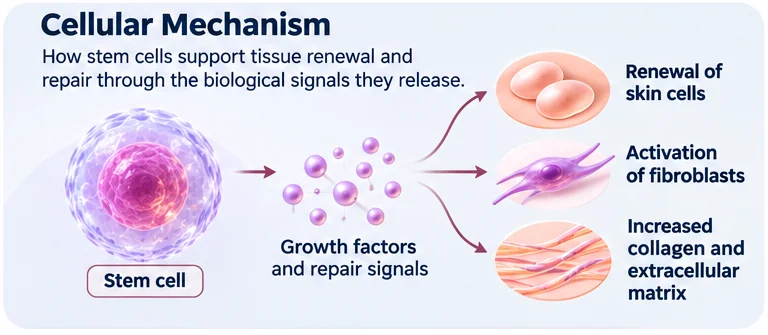
Research has shown that mesenchymal cells release growth factors, cytokines and extracellular vesicles, and that these signals may stimulate fibroblasts, modulate the inflammatory response and influence the formation of blood vessels. A large share of these findings comes from cell culture and animal studies. Laboratory findings are not the same as a clinical result proven in humans.
Collagen and Elastin
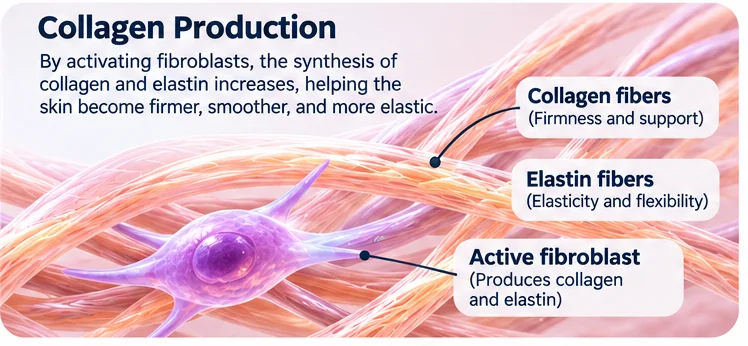
Collagen gives the skin strength and elastin gives it elasticity. Both are produced by fibroblasts in the dermis. Some clinical studies on regenerative applications have reported improvements in measurements of collagen density and elasticity; however, because study sizes, measurement methods and follow-up periods differ, these results cannot be generalised.
Cellular Applications Derived from Fat Tissue: ADSC and SVF
SVF (Stromal Vascular Fraction)
SVF is a mixed (heterogeneous) cell population obtained by processing a sample of the person's own fat tissue. Besides fat-derived stem/stromal cells, it contains blood vessel wall cells, immune cells and other cell types. Harvesting fat requires a minor surgical procedure.
ADSC (Adipose-Derived Stem/Stromal Cells)
ADSC refers to mesenchymal stem/stromal cells isolated from fat tissue. They are a component of SVF but are not the same as SVF: ADSCs are usually isolated in the laboratory and expanded in culture. Some studies have used the culture medium of these cells (conditioned medium) instead of the cells themselves; this is yet another, separate product.
PRP
PRP (platelet-rich plasma) is plasma with an increased platelet concentration, prepared by centrifuging a sample of the person's own blood. PRP does not contain stem cells. Its effect is thought to come from growth factors released by platelets. The literature has also examined combinations in which SVF is used together with PRP or laser; this does not mean that PRP itself is a cell therapy.
Exosomes
Exosomes are very small, membrane-enclosed extracellular vesicles released by cells. They are not cells and cannot multiply; they take part in communication between cells through the proteins, lipids and RNA molecules they carry. Products differ widely in source (human, animal, plant), manufacturing method and content, and they are not standardised. The U.S. Food and Drug Administration (FDA) has issued a consumer alert on stem cell and exosome products; this alert concerns U.S. regulations and does not replace the legislation in Türkiye.
Laboratory-Processed or Expanded Cellular Products
Isolating cells in the laboratory, expanding them in culture or changing their properties may move a product into a different regulatory category than a simple tissue preparation. In Türkiye, this field is governed by the “Regulation on Products Obtained from Human Tissues and Cells and Related Centres” (İnsan Doku ve Hücrelerinden Elde Edilen Ürünler ve Bu Ürünler ile İlgili Merkezler Hakkında Yönetmelik), published in the Official Gazette (Resmî Gazete) No. 33007 of 4 September 2025. According to an announcement by the Turkish Medicines and Medical Devices Agency (TİTCK), the regulation entered into force on 1 January 2026.
Some definitions in the regulation (Article 4, summarised):
- Minimal manipulation: Limited procedures such as cutting, centrifugation, cell separation, concentration, filtration or freezing that do not change the original biological characteristics and functions of the tissue or cells.
- Substantial manipulation: Procedures that change the original biological characteristics, physiological functions or structural properties of the tissue or cells.
- Advanced therapy medicinal product: Where tissues and cells are the starting material, a product that meets at least one of the criteria of substantial manipulation, systemic effect or non-homologous use.
The scope article of the regulation (Article 2) also excludes certain areas, such as blood components and blood banking, and tissues and cells of animal, plant or synthetic origin. TİTCK has published guidelines on the licensing of centres (19.02.2026) and on the registration of human tissue and cell products (28.03.2026).
Treatment Process
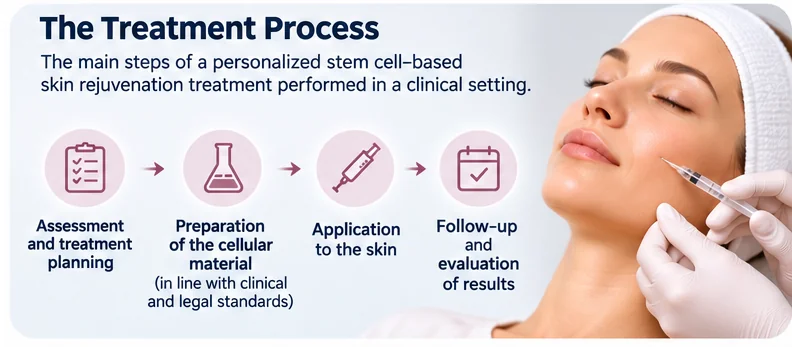
- Assessment and planning: At the examination, skin structure, concerns, medical history and expectations are discussed, and it is decided whether a suitable method exists.
- Preparation: Preparation depends on the chosen method; for example, blood is drawn for PRP, while SVF requires fat tissue to be harvested.
- Application: As described on our existing page, the application may be combined with microneedling, the mesotherapy technique or device-assisted methods.
- Check-up and follow-up: The healing process and the response are evaluated at follow-up examinations.
The application is non-surgical and return to daily life is usually quick; however, this may differ for methods that require fat tissue to be harvested. When an effect becomes visible depends on the chosen method and the individual response of the skin. There is no standard protocol for the number of sessions or the intervals between them.
Who May Be Suitable?
It may be considered as a supportive approach for people with dull skin, signs of tiredness, fine lines or reduced skin quality. Suitability is decided individually, taking expectations, skin structure, general health and examination findings into account together.
Conditions such as an active skin infection, pregnancy/breastfeeding, certain blood and immune disorders, the use of blood thinners or a history of cancer may require additional evaluation or may prevent the application.
Risks and Safety
Risks differ by method:
- All injection/needling applications: Redness, swelling, bruising, temporary pain; rarely infection.
- PRP: Because it is prepared from the person's own blood, the risk of allergy is low; side effects related to blood draw and injection may occur.
- SVF: Pain, bruising, infection and scarring at the fat harvesting site; risk of contamination during cell processing.
- Laboratory-expanded cells: Manufacturing standards, contamination and limited long-term safety data are important issues.
- Exosome products: Because there is no standard for content and source, products vary and carry a risk of contamination; long-term safety data are limited.
In its consumer alert, the FDA states that there is a great deal of misleading information about these products online, that some illegally marketed products have not been shown to be safe or effective and may pose serious safety concerns, and that there are currently no FDA-approved exosome products in the United States. This information concerns U.S. regulations. The source of a product, its legal status and the authorisation of the centre performing the application should always be questioned.
Comparison of Methods
| Method | Biological structure | Source | Contains cells? | Evidence (skin) |
|---|---|---|---|---|
| PRP | Platelet-rich plasma | The person's own blood | No stem cells | Widely used; studies are heterogeneous |
| SVF | Heterogeneous cell fraction | The person's own fat tissue | Yes, mixed cells | Limited, small studies |
| ADSC | Adipose-derived mesenchymal stem/stromal cells | Fat tissue, expanded in the laboratory | Yes | Limited; low to moderate certainty |
| Exosomes | Extracellular vesicles | Variable (human, animal, plant cell cultures) | No | Early stage; no standard |
Frequently Asked Questions
Is PRP a stem cell treatment?
No. PRP (platelet-rich plasma) is plasma with an increased platelet concentration obtained from the person's own blood. It contains no stem cells; the growth factors are released by platelets.
Are exosomes the same as stem cells?
No. Exosomes are small, membrane-enclosed extracellular vesicles released by cells. They are not cells themselves and cannot multiply; they play a role in communication between cells through the proteins and genetic material they carry.
What is the difference between SVF and ADSC?
SVF (stromal vascular fraction) is a mixed (heterogeneous) cell population isolated from fat tissue that contains fat-derived stem cells as well as vascular, immune and other cell types. ADSC refers to the adipose-derived mesenchymal stem/stromal cells within this population; they are usually isolated and expanded in the laboratory.
Has the effect of stem cell–derived applications been proven?
Promising findings have been reported in studies on skin quality; however, the number of studies is small, the methods vary and the certainty of evidence is low to moderate. A definitive result that applies to everyone should therefore not be expected.
Are the results permanent, and how many sessions are needed?
There is no standard, proven protocol for how long results last or how many sessions are needed. Planning is done by the physician after an examination, based on the person's skin structure and the chosen method.
How are cellular products regulated in Türkiye?
In Türkiye, products obtained from human tissues and cells and the related centres are regulated by the regulation published in Official Gazette No. 33007 of 4 September 2025 and by the guidelines of the Turkish Medicines and Medical Devices Agency (TİTCK). Which category an application falls into is assessed according to its method and how the product is processed.
Let us assess the right approach for you at an examination
At Assoc. Prof. Dr. Hüray Hügül's clinic, your skin structure, expectations and medical history are evaluated to discuss whether a suitable approach exists for you.
Contact and AppointmentRelated Blog Posts
- What is Hair Thinning in Women? What Causes It and How Can It Be Supported?
Female hair thinning is a multifactorial process related to hormonal changes, genetic predisposition, stress, nutritional deficiencies, thyroid problems, and scalp health. After an evaluation by Associate Professor Hüray Hügül at our Antalya clinic, the type and cause of hair loss are examined, and hair mesotherapy, PRP, scalp care, and personalized support protocols can be planned.
- Why Does Ear Itching Increase During Menopause? What is Itchy Ears?
During menopause/perimenopause, as estrogen decreases, the skin can become drier, thinner, and more sensitive. Cleveland Clinic states that declining estrogen can lead to moisture loss, thinning, barrier weakness, and a tendency to itchiness in the skin. Since the inside of the ear canal is essentially a "small tunnel covered in skin," this dryness can also be felt there.
References
- İnsan Doku ve Hücrelerinden Elde Edilen Ürünler ve Bu Ürünler ile İlgili Merkezler Hakkında Yönetmelik [Regulation on Products Obtained from Human Tissues and Cells and Related Centres]. Resmî Gazete (Official Gazette of the Republic of Türkiye), 04.09.2025, No. 33007. resmigazete.gov.tr
- Republic of Türkiye Ministry of Health, Antalya Provincial Health Directorate — full text of the regulation (in Turkish). antalyaism.saglik.gov.tr
- TİTCK (Turkish Medicines and Medical Devices Agency). Guideline on the licensing of centres for human tissues and cells and products obtained from them (announcement, 19.02.2026, in Turkish). titck.gov.tr
- TİTCK. Guideline on issuing registration certificates for human tissue and cell products (announcement, 28.03.2026, in Turkish). titck.gov.tr
- U.S. Food and Drug Administration. Consumer Alert on Regenerative Medicine Products Including Stem Cells and Exosomes. fda.gov
- Chon J, Randall SE, Schumann TA, et al. A Systematic Review of Adipose-Derived Cell Therapies on Skin Quality. Aesthet Surg J Open Forum. 2025;7:ojaf098. PubMed 40852442
- Al-Dhubaibi MS, Mohammed GF, et al. Stem Cell-Based Therapies for Skin Rejuvenation: A Systematic Review of Clinical Efficacy, Safety, and Underlying Mechanisms. J Cosmet Dermatol. 2026;25:e71186. PMC13555514
- Category: Medical Dermatology and Skin Applications
- Category: Facial Aesthetics & Medical Aesthetics
- Method: Mesotherapy
- Area: Neck
- Area: Face
- Area: Under chin (Double chin)
- Area: Hand
- Area: Eye area
- Area: Temple
- Area: Décolletage
- Area: Hair
- Area: Forehead
- Area: Chin
- Area: Cheekbone
- Concern: Acne scar
- Concern: Loss of elasticity
- Concern: Hair loss
- Concern: Wrinkles
- Concern: Sagging
- Concern: Pore
- Concern: Redness
- Concern: Spot
- Concern: Skin dullness
- Concern: Fine lines
- Concern: Dark under-eye circles
- Concern: Uneven skin tone
- Concern: Volume loss