Mole Examination: Which Moles Should Be Inspected and What Are the Signs of Change?
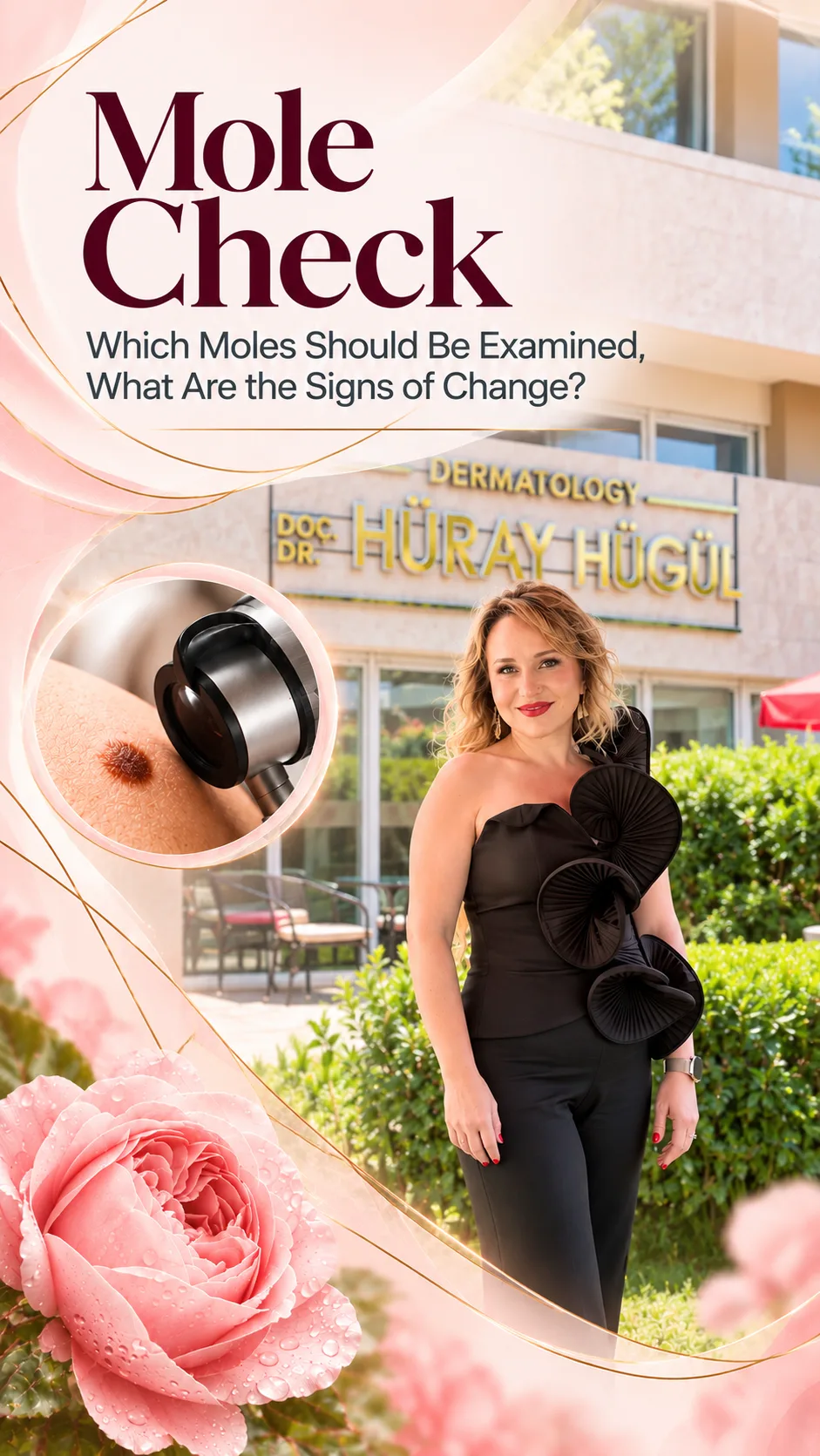
Mole Check: Which Moles Should Be Examined, What Are the Signs of Change?
Everything you need to know about mole examinations in Antalya, signs of change in moles, and skin health.
Most moles on our skin are benign. However, changes in shape, color, or size appearing in some moles may require a dermatological evaluation. Especially for individuals frequently exposed to the sun, getting to know one's skin, noticing new formations, and regularly observing existing moles is crucial.
For those living in Antalya and spending time outdoors year-round, the habit of sun protection and monitoring skin health carries extra importance. Waiting for the summer season to end or for a mole to grow larger is not the correct approach for evaluating a suspicious mole.
In this guide prepared for those seeking information about mole examination at Assoc. Prof. Dr. Hüray Hügül’s clinic in Antalya, we discuss which moles should be checked, how to perform a mole self-check at home, and in which cases a biopsy might be necessary.
Which Moles Should Be Examined?
Not all moles share the same characteristics. Some may be present from childhood, while others appear later in life. A mole being dark-colored, raised, or large does not alone mean it is malignant. What matters is the mole's overall appearance, whether it differs from other moles, and if it shows changes over time.
It is recommended to consult a dermatology specialist if any of the following conditions exist:
- A significant change occurs in the size, shape, or color of the mole.
- The edges become irregular or the borders become blurred.
- Multiple color tones are seen on the same mole.
- A new spot or mole appears that looks significantly different from other moles.
- The mole bleeds spontaneously, crusts, itches, or becomes painful.
- A wound appears that does not heal or heals and then reopens.
The presence of these symptoms does not necessarily mean skin cancer is present. However, the cause must be evaluated. The examination of a suspicious formation should not be delayed.
What is the ABCDE Rule in Mole Checking?
The ABCDE rule is one method that helps in noticing potential risk signs in moles. This method is a practical guide to use when observing skin changes, but it is not sufficient for making a definitive diagnosis.
A: Asymmetry
If one half of the mole does not match the other half, asymmetry may be present.
B: Border
If the edges of the mole look irregular, notched, or blurred, it needs evaluation.
C: Color
The presence of different colors such as brown, black, red, white, or bluish within the same mole is a feature to watch out for.
D: Diameter
Moles larger than 6 millimeters in diameter should be evaluated more carefully. However, suspicious changes can also be seen in smaller moles.
E: Evolving
The mole growing over time, changing shape or color, or its appearance becoming different is an important warning sign.
There are also some skin cancers that do not fit any of the ABCDE criteria. Therefore, instead of relying solely on this rule, you should also take into account new formations or changes on your skin that seem different to you.
How to Perform a Mole Check at Home?
Regular skin checks at home can help early detection of new moles and changes in existing ones. However, a self-check does not replace an examination by a dermatology specialist.
Examining your skin once a month in a well-lit environment is a practical start. If a dermatology specialist has recommended checks at specific intervals, follow that schedule.
Step-by-Step Mole Check
- Examine your face and neck. Also check your ears, hairline, and scalp. You can use a hand mirror or the help of a relative to see areas on the scalp.
- Check your arms and hands. Examine the armpits, elbows, palms, and nails.
- Observe your torso. Check the chest, abdomen, back, and waist areas. You can use a hand mirror or ask a relative for help to see your back.
- Examine your legs and feet. The thighs, behind the knees, the back of the legs, the top of the feet, the soles, between the toes, and the nails should be checked.
- Record changes. Saving photos of moles with dates can help you compare differences over time. Photos are not sufficient for diagnosis.
If you notice a new formation or think an existing mole has changed, do not wait for the next monthly check.
Who Should Have Their Moles Checked More Frequently?
The risk of skin cancer is not the same for everyone. Some individuals may have a higher need for dermatological evaluation and follow-up.
- Those with a large number of moles on their body.
- Those with a family history of melanoma or other skin cancers.
- Fair-skinned individuals with light-colored eyes, blonde or red hair, or freckles.
- Those who have had severe sunburns, especially during childhood.
- Individuals previously diagnosed with melanoma or another skin cancer.
- Those with many atypical moles (moles that look different from ordinary ones).
- Individuals receiving procedures that suppress the immune system or who have specific risks related to the immune system.
Having one of these characteristics does not necessarily mean skin cancer will develop. Mole examination and follow-up intervals should be determined according to the person's risk status, skin characteristics, and previous examination findings.
How Does Sun Exposure in Antalya Affect Moles?
Antalya's sunny climate increases the importance of time spent outdoors and sun protection habits. Spending time at the seaside, doing outdoor sports, or working outside for long periods during the day can increase exposure to ultraviolet (UV) rays.
Excessive and unprotected exposure to UV rays is among the major factors increasing the risk of skin cancer. Especially sunburns and UV exposure accumulated throughout life should be considered for skin health.
However, not every new mole is directly sun-related, and sun protection does not prevent the formation of all existing moles. The goal is to protect the skin from unnecessary UV exposure and to notice suspicious changes early.
What Can Be Done for Sun Protection in Antalya?
- Reduce time spent directly under the sun during hours when solar radiation is intense, especially between 10:00 and 16:00.
- Use a broad-spectrum sunscreen providing at least SPF 30 protection. Renew the product according to instructions, especially after swimming, sweating, or towel drying.
- Choose hats, sunglasses, and clothing that covers the skin.
- Utilize shaded areas. Remember that shade alone does not provide full protection against UV rays.
- Avoid solariums.
- Regularly check your skin even if you are using sunscreen.
If you spend time outside year-round in Antalya, sun protection should not be seen as a habit unique only to summer holidays.
How is a Mole Examination Performed in the Clinic?
The primary goal of a mole examination is to evaluate the characteristics of formations on the skin and identify areas that require more detailed investigation.
During the procedure, the dermatology specialist evaluates the appearance, distribution, borders, color characteristics of the moles, and any changes over time. The person's family history, previous skin diseases, sunburns, and other risk factors also contribute to the evaluation.
Evaluation with Dermatoscope
A dermatoscope is a device that helps examine details on the skin surface and in pigmented lesions by magnifying them. This method can facilitate the evaluation of some features that cannot be seen with the naked eye.
While dermatoscopic examination is useful in evaluating a suspicious formation, it does not provide a definitive diagnosis on its own in every case. Biopsy and pathological examination may be required for some lesions.
Digital Mole Tracking
In individuals deemed appropriate, photographing moles or recording them with digital imaging methods can help compare changes in subsequent examinations.
Not every patient needs digital tracking. Whether these methods will be used is determined based on the person's risk status, the characteristics of their moles, and the clinical evaluation.
Pre-publication clinical note: The devices and digital tracking facilities used in Assoc. Prof. Dr. Hüray Hügül Clinic should be verified by the clinic. Brand or model information of the device used should not be stated without verification.
In Which Situations is Mole Removal or Biopsy Necessary?
Not every mole needs to be removed. The decision for mole removal is made by evaluating the mole's appearance, symptoms, location, the person's complaints, and medical necessities together.
If there is suspicion that a mole might be malignant or if the diagnosis needs to be finalized, the physician may recommend a biopsy or an appropriate surgical removal method. In some cases, removal may also be evaluated for reasons such as the mole causing discomfort due to friction.
What is a Biopsy?
A biopsy is the taking of a tissue sample from a formation to be examined in a laboratory. If there is a suspicious situation in moles, it can help confirm the diagnosis. In some lesions, the entire formation is removed and sent for pathological examination.
How the procedure is performed varies according to the characteristics of the lesion and the physician's evaluation.
How Does the Mole Removal Process Work?
- Examination: The characteristics of the mole and whether it needs to be removed are evaluated.
- Determination of method: The appropriate procedure is selected based on the structure of the lesion and clinical necessity.
- Procedure: Local anesthesia is applied when necessary. The details of surgical removal or biopsy may vary per individual.
- Pathological examination: Samples deemed medically necessary are examined in the laboratory.
- Result and follow-up: The pathology result is evaluated, and a subsequent care or follow-up plan is created if necessary.
It is not correct to try to cut, burn, or destroy a suspicious mole with chemical products at home or without expert evaluation for purely aesthetic concerns. Such attempts can lead to injury, infection, and delayed diagnosis.
If a mole needs to be removed, the primary priority is a safe procedure and an accurate diagnosis. Whether a scar remains after the procedure depends on the method used, the area where the mole is located, and the individual's wound-healing characteristics.
Moles in Children: What Should Families Watch Out For?
The formation and growth of moles in children can be a part of the developmental process. However, it is not correct to automatically assume that every mole appearing in childhood is harmless.
Families should pay attention to these changes in particular:
- New formations that appear significantly different from other moles.
- Rapid or distinct changes in size, shape, or color.
- Lesions that bleed spontaneously, crust, or do not heal.
- Moles that constantly itch, ache, or show sensitivity.
Age, the development of the mole, family history, and other clinical features are considered in the evaluation of moles in children. When a suspicious change is noticed, a specialist experienced in pediatric dermatology or a suitable dermatology specialist should be consulted.
It is also important to gain the habit of sun protection during childhood. Measures such as sunscreen use, staying in the shade, and choosing hats and protective clothing can be applied by the whole family.
When Should You Apply for a Mole Examination in Antalya?
If you have noticed a mole on your skin changing, if a new formation has appeared that looks different from your other moles, or if a mole is bleeding spontaneously, crusting, or constantly itching, do not delay a dermatological evaluation.
It is especially important for individuals with a family history of skin cancer or those with many or atypical moles to learn the follow-up plan suitable for them.
You can plan a suitable appointment for the evaluation of formations on your skin by obtaining information about mole examination from Assoc. Prof. Dr. Hüray Hügül’s clinic in Antalya. The examination and follow-up method should be determined according to your personal needs and clinical evaluation results.
Remember: Not every change in moles means cancer. However, early evaluation can help ensure that a significant skin change is not overlooked.
Frequently Asked Questions
Is the growth of a mole a sign of skin cancer?
The growth of a mole alone does not diagnose skin cancer. However, if there are symptoms such as change in size, color differentiation, irregular borders, or bleeding, it should be evaluated by a dermatology specialist.
How often should mole checks be performed?
Observing your skin once a month for a home check is a practical approach. The frequency of a professional dermatology examination should be determined based on the individual's risk factors and previous examination findings.
Should every mole be removed?
No. Not every mole needs to be removed. The decision is made by evaluating the mole's appearance, symptoms, and medical requirements. Biopsy or surgical removal may be necessary for suspicious formations.
Does a dermatoscope definitively show if a mole is cancerous?
A dermatoscope helps in the detailed evaluation of the mole but does not provide a definitive diagnosis in every case. Biopsy and pathological examination can be performed in cases deemed necessary.
Does exposure to the sun in Antalya make mole checking more important?
Spending frequent time under intense sun in Antalya can increase UV exposure. It is important to protect yourself from the sun, observe the skin regularly, and consult a dermatology specialist for suspicious changes.
This content is for informational purposes; it does not replace personal examination, diagnosis, or professional medical care.