Fractional Laser in Antalya: Which Skin Concerns Does It Address?
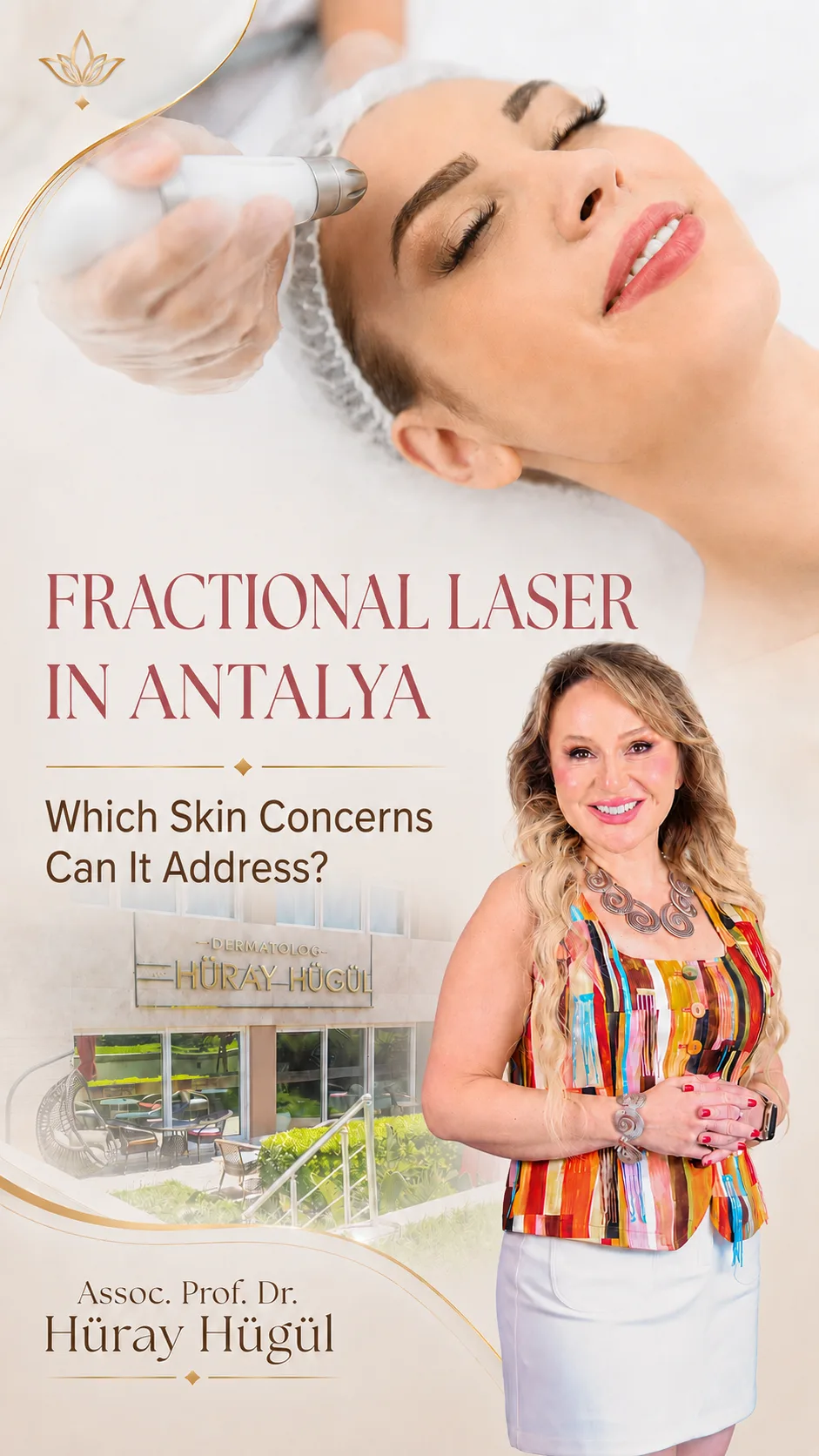
Antalya Fractional Laser
Fractional laser is a modern technology that initiates controlled regeneration in both superficial and deep skin layers by creating micro-channels. In Antalya, it is a frequently preferred method, especially for acne scars and skin rejuvenation needs.
Brief Summary
In this article, we explain the working principle of fractional laser applications in Antalya, which skin concerns they affect, the number of sessions, and the recovery process in simple terms.
How Does Fractional Laser Work?
Fractional laser delivers energy to microscopic points, not the entire skin, leaving healthy tissue in between. This ensures both rapid healing and effective collagen regeneration.
There are ablative (surface-removing, e.g., CO2/Erbium) and non-ablative (surface-preserving) types, chosen based on the specific skin concern.
Which Skin Concerns Is It Effective For?
Acne scars (especially "ice pick" and "boxcar" types), striae (stretch marks), enlarged pores, fine lines, sun-damaged spots, and reduced skin texture quality benefit from this approach.
For active, deep melasma, it is not a primary care; pigment control should be established first.
How Many Sessions Are Needed, and What Are the Intervals?
Generally, 3-5 sessions are planned; there is a 4-6 week waiting period between sessions. This number may increase for acne scars.
The effect is cumulative; a dramatic difference is not expected after the first session. The main improvement takes 3-6 months as collagen regeneration takes time.
Recovery Process and Social Downtime
For ablative fractional laser, redness and mild scabbing are observed for 5-7 days; for non-ablative applications, it is limited to temporary redness for 2-3 days.
Therefore, autumn-winter months are preferred over the summer holiday period in Antalya; sun protection is essential.
Which Season is Ideal for Antalya's Climate?
Due to high sun intensity, the period between October and March is safer for ablative applications. Non-ablative applications can be performed year-round with SPF 50+.
Intense sun exposure should be avoided for 2 weeks before and 4-6 weeks after the session; otherwise, there is a risk of pigment changes.
Side Effects and Risks
The most common temporary effects are redness, mild swelling, and scabbing. Permanent pigment changes or, rarely, scarring can occur with improperly performed applications.
The application is not performed in cases of active infection, pregnancy, or within the waiting period after isotretinoin (acne medication) use.
Medical Information
This content has been prepared for general informational purposes. Suitability for the application, planning, dosage, and post-procedure recommendations are determined solely by the evaluation of a specialist physician.
Frequently Asked Questions
01How much do fractional laser applications in Antalya improve acne scars?
It provides a significant reduction of 40-70% depending on the type of acne scar; complete eradication should not be expected in every case.
02What is the difference between fractional laser and peeling?
Peeling is superficially effective; fractional laser reaches deeper layers through micro-channels and stimulates collagen production.
03Is the procedure painful?
It is well-tolerated with topical anesthesia; anesthesia may not be necessary for non-ablative systems.
04When are the results visible?
Skin texture improvement is felt within the first 2-4 weeks; the full effect is achieved within 3-6 months.
Assessment for personalized fractional laser planning for your skin in Antalya
The selection of the correct fractional technology based on your goals for acne scars, pores, spots, or skin rejuvenation determines the outcome. Get a personalized plan in Antalya at Assoc. Prof. Hüray Hügül Clinic.
Explore fractional applications page